


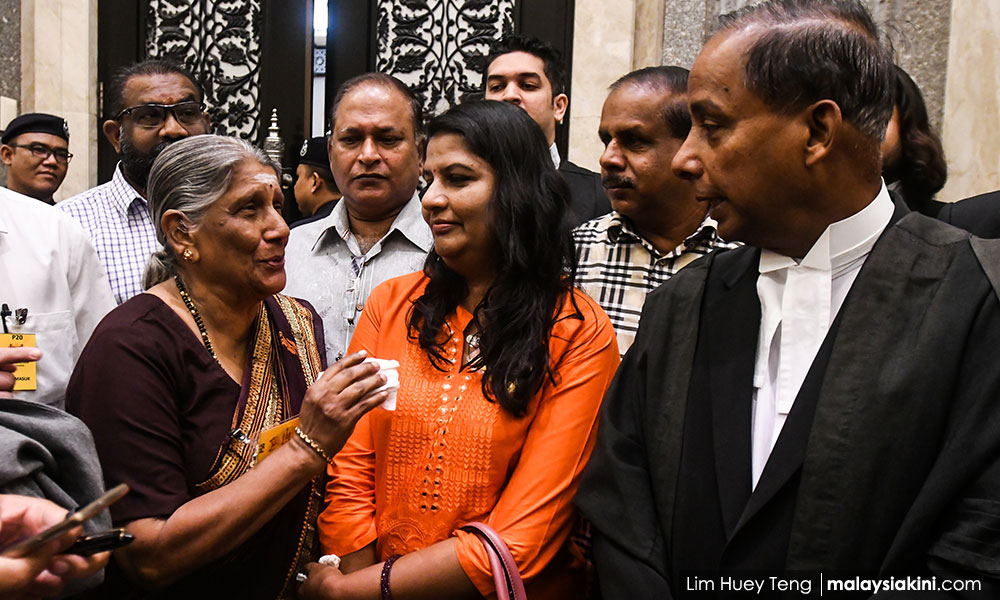

Apex court rules in favour of Indira Gandhi in unilateral conversion case
The Federal Court today ruled that the definition of "parent" should be plural, in its verdict in the unilateral conversion case involving the children of M Indira Gandhi and her ex-husband Muhammad Riduan Abdullah.
This is a departure from the 2007 verdict in the case of R Subashini vs T Saravanan, which saw the wife instructed to seek recourse through the Syariah Appeals Court over her convert husband converting their children to Islam without her consent.
Court of Appeal president Justice Zulkefli Ahmad Makinudin, who led the bench, said the decision was unanimous, and stressed that although unilateral conversion is a contentious issue, today's decision was not swayed by the judges' religious convictions...
The Federal Court today ruled that the definition of "parent" should be plural, in its verdict in the unilateral conversion case involving the children of M Indira Gandhi and her ex-husband Muhammad Riduan Abdullah.
This is a departure from the 2007 verdict in the case of R Subashini vs T Saravanan, which saw the wife instructed to seek recourse through the Syariah Appeals Court over her convert husband converting their children to Islam without her consent.
Court of Appeal president Justice Zulkefli Ahmad Makinudin, who led the bench, said the decision was unanimous and stressed that although unilateral conversion is a contentious issue, today's decision was not swayed by their religious convictions.
Federal Court judge Justice Zainun Ali, who read the 99-page unanimous decision, ruled that the civil court has jurisdiction to review the actions of the Registrar of Muallafs (Muslim converts) if there is illegality.
Today's decision means is that if there are questions regarding the conversion of a person even to Islam the dispute can be heard by a civil court as opposed to the syariah courts.
Three questions of law were posed to the court:
1) Whether the High Court has exclusive jurisdiction, pursuant to Sections 23, 24 and 25 and the Schedule of the Courts of Judicature Act 1964 (read together with Order 53 of the Rules of Court 2012) and/or its inherent jurisdiction to review the actions of the Registrar of Muallaf or his delegate acting as the public authority in exercising statutory powers vested by the Administration of the Religion of Islam (Perak) Enactment 2004;
 2) Whether a child of a marriage registered under the Law Reform (Marriage and Divorce) Act 1976, who has not attained the age of 18 years, must comply with both Sections 96 (1) and 106 (b) of the Administration of the Religion of Islam (Perak) Enactment 2004 (or similar provisions to state laws throughout the country), before the Registrar of Muallaf or his delegate may register the conversion to Islam of that child; and,
3) Whether the mother and father (if both are still surviving) of a child of a civil marriage must consent before a certificate of conversion to Islam can be issued in respect of the child.
The court answered all three questions in the affirmative and ruled that the Registrar of Muallafs has no right to register a child if he or she does not recite the Islamic affirmation of faith, the kalimah syahadah.
Thus, the court ruled that the permission of both parents is needed in changing the faith of the child, and in doing so, set aside the decision of the Court of Appeal.
Applies to future cases
The decision today would apply to future unilateral conversion cases but not applied retrospectively, said Justice Zainun.
"For the avoidance of any doubts, our decision in these appeals is to have prospective effect. The doctrine of prospective overruling will apply here so as not to give retrospective effect to decisions of the courts which had already taken place prior to the date of this judgment."
In its landmark decision, the Federal Court allowed all three appeals made by Indira Gandhi against the education ministry, the Registrar of Muallaf and her husband K Patmanathan @ Muhammad Riduan Abdullah.
Justice Zainun said the civil court had the power to review a decision on its constitutional role as a check and balance mechanism.
"It cannot be abrogated or altered by Parliament by way of a constitutional amendment […] it is evident from the marked differences in the establishment and constitution of the civil and Syariah courts that the two courts operate on a different footing altogether.
"The powers of judicial review and of constitutional or statutory interpretation are pivotal constituents of the civil court's judicial power under Article 121 (1),” she said.
Contrasting the jurisdiction of the syariah court and applying it on this case, Justice Zainun said the determination of the present appeals did not involve the interpretation of any Islamic personal law or principles.
"The subject matter in the appellant (Indira Gandhi's) case is not concerned with the status of her children as Muslims converts or with the question of Islamic personal law and practice, but rather with the more prosaic questions of the legality and constitutionality of administrative action taken by the registrar (of muallaf) in the exercise of his statutory powers.
"In these circumstances and in view of the views expressed, we have no difficulty in concluding that the High Court is seized with jurisdiction, to the exclusion of the Syariah Court to hear the matter and has rightly done so," she said in answering the first question in the affirmative.
Children did not utter “kalimah”
Justice Zainun said the undisputed evidence in Indira Gandhi's case is that her children did not utter the two clauses of the affirmation of faith (kalimah syahadah) and were not present before the Registrar of Muallaf before the certificate of conversion was issued.
Hence, she said this was the requirement of Section 96 (1) of the Religion of Islam (Perak) Enactment 2004.
Citing the principles in a 1969 case, Justice Zainun said the lack of jurisdiction by the registrar renders the certificates issued a nullity.
"Section 101 (2) cannot have the effect of excluding the court's power of judicial review over the registrar's issuance of the certificate. It is settled law that the supervisory jurisdiction of courts to determine the legality of administrative action cannot be excluded even by an express ouster clause.
"In the instant appeal, the fact of the conversion or the registration of Indira Gandhi's children are not challenged. What is challenged is the legality of the conversion and registration," she said in answering the second question in the affirmative.
Need consent of both parents
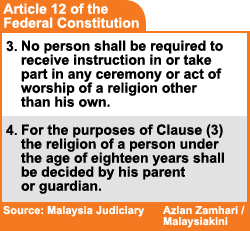
On the third question, Justice Zainun said the central question involved Article 12 (4) of the Federal Constitution on which the religion of a person under the age of 18 shall be decided by the parent or guardian, where emphasis had been made on the literal meaning of the singular noun.
The judge said the child's religious upbringing was of paramount consideration to the court so as to safeguard the welfare of the child.
She said since custody of the children had been granted to Indira Gandhi, it is she who exercised the dominant influence in their lives.
"To allow the other spouse to unilaterally convert the children without the consent of the wife would amount to a serious interference of lifestyle. In our view, in the case of Teoh Eng Huat vs Kadhi Pasir Mas and another, does not stand for the proposition that the word 'parent' in Article 12 (4) means a single parent.
"It is noted that in translating Article 12 (4) of the Federal Constitution, it would appear that the real essence of the English version is eluded. It is literally a case of being lost in translation.
“The reason parent is used in Article 12 (4) is to provide for a situation where indeed there is only one parent of the child i.e. single parent situation. But where both parents exist, then the Eleventh Schedule shall be relied upon."
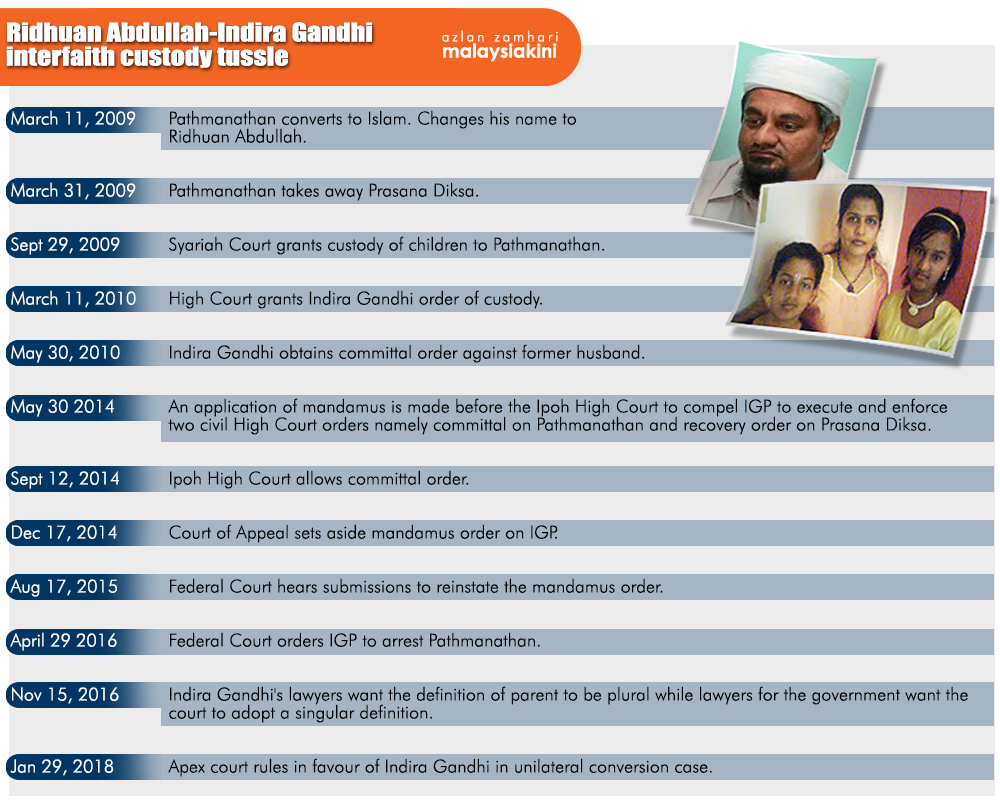
Citing the Guardianship of Infants Act 1961 (GIA), as in Indira Gandhi's situation where the youngest, then 11-month old Prasana Diksa - was taken by the husband in 2009, the judge said the children in question are children of the Hindu marriage between Indira Gandhi and Patmanathan @ Riduan.
Under the GIA, Justice Zainun said both parents have equal rights in relation to the custody and upbringing of the infant child and the wishes of both are taken into consideration.
"The conversion of the husband to Islam does not alter the antecedent legal position, nor does it bring the children out of the ambit of the GIA.
"Based on a purposive interpretation of Article 12 (4) read with the Eleventh Schedule of the constitution, and on an application of Sections 5 and 11 the GIA, it is concluded that the consent of both the appellant and her husband are required before a certificate of conversion to Islam can be issued in respect of the children," Justice Zainun said.

With this, Justice Zainun ruled that the previous certificates of conversion to the three children were void and must be set aside.
"For the reasons above stated, we allow all three appeals by Indira Gandhi. The majority decision and the orders of the Court of Appeal are hereby set aside and we affirm the decision and orders of the High Court," she said.
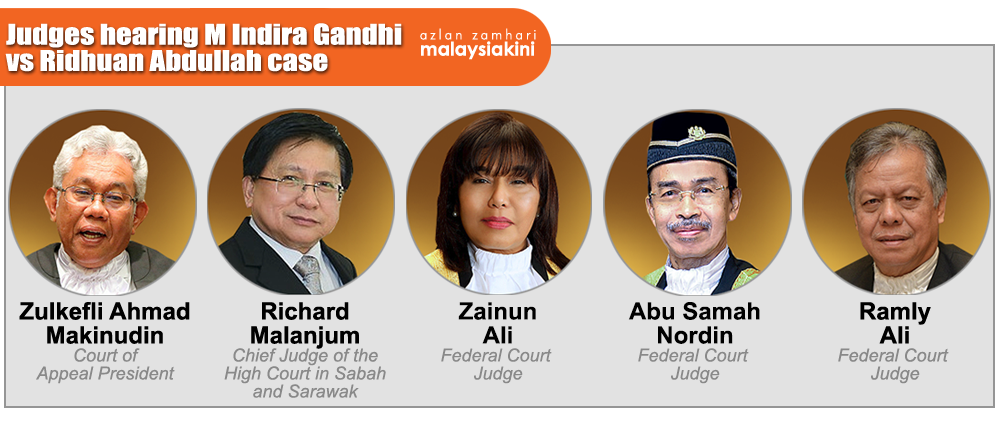
The other judges on the panel beside Justice Zulkefli were Chief Judge of Sabah and Sarawak Justice Richard Malanjum, and Federal court judges Justice Abu Samah Nordin and Justice Ramly Ali.
On Aug 2, 2013, then Ipoh High Court judge Justice Lee Swee Seng had ruled that unilateral conversion of Indira's three children by her ex-husband was against international norms and that the civil courts were superior to the syariah courts.
Despite managing to set aside the conversion of her children, the whereabouts of Prasana Diksa who was taken by Riduan is still unknown.
A warrant of arrest has been issued for the father.


Are you sure you want to delete this comment?
This action cannot be undone.